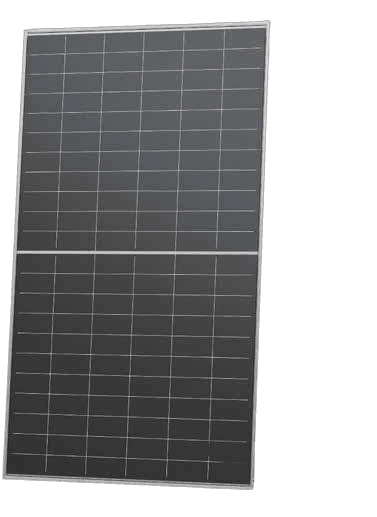
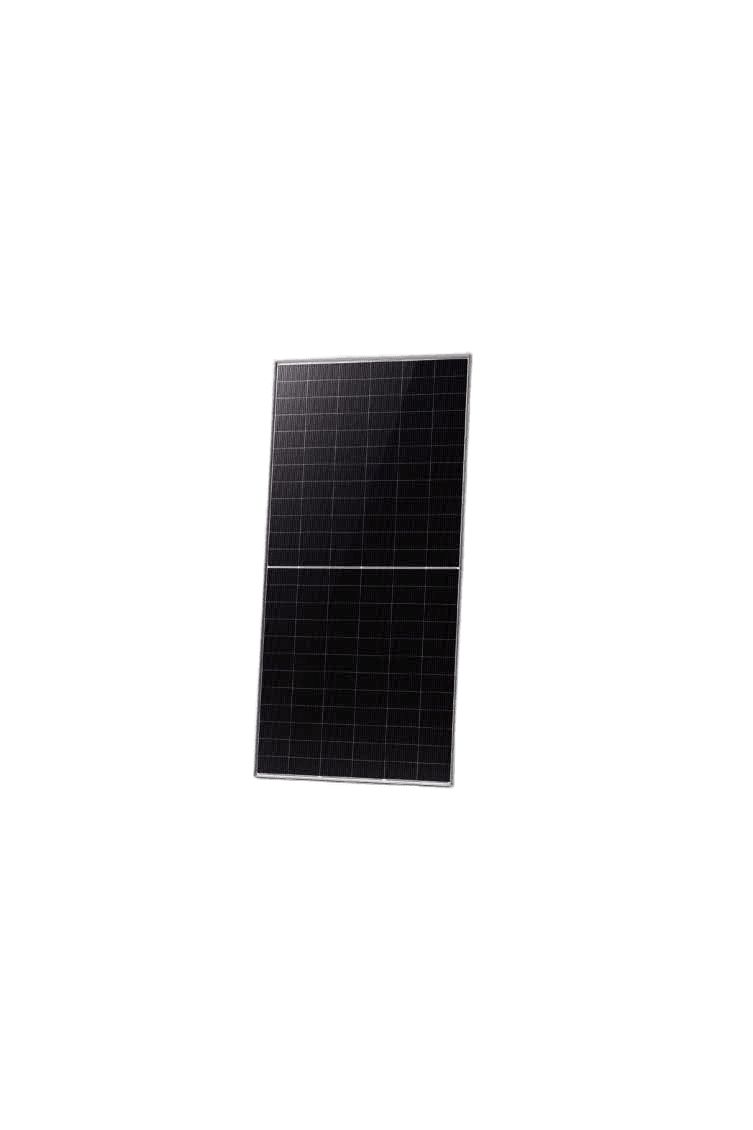
A Jinko Solar datasheet read line by line on the 620 W module: what Pmax, Voc, Isc and the temperature rows mean, and which family page holds each wattage.
A Jinko datasheet is two pages and about forty numbers, and most people read one of them: the watts. The rest decide how many panels go on a string, what the roof carries, what a hot afternoon takes away and what you can hold the maker to. This guide reads one sheet from top to bottom, the JKM620N-66HL4M-BDV-F6, using the figures in its product record, and then shows where the sheet for every other wattage lives.
Products mentioned in this article
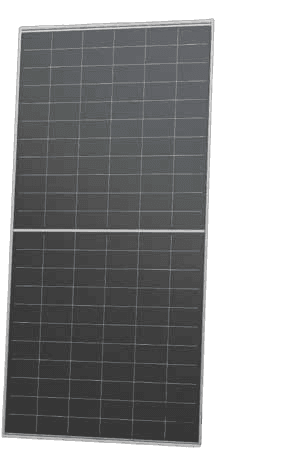
N-Type Bifacial Solar Panel 620 W
- Maximum Power (Pmax):620W
- Module Efficiency:22.95%
First: one datasheet covers six wattages
Jinko prints one sheet per family, not per panel. The 605–630 W family datasheet carries six columns, 605, 610, 615, 620, 625 and 630 W, over a single mechanical drawing. The six panels are the same glass, frame and cell count; they are sorted into power classes after manufacture. So "the 620 W datasheet" and "the 615 W datasheet" are the same document, read in different columns.
Reading the model code
JKM620N-66HL4M-BDV-F6 is not a serial number; it is a description. The 620 is the rated power, and the Pmax row confirms it. The N marks an N-type cell, and the cell-type row reads "N-type Mono-crystalline". The 66 matches the cell row, 132 (66×2): sixty-six cells, each cut in half. In this catalogue the families whose code carries BDV are listed as bifacial, and those with DV or DB alone are mono-facial.
The electrical block
These five rows are measured under standard test conditions: 1,000 W/m² of light on a cell at 25 °C.
| Row | 620 W column | What it is for |
|---|---|---|
| Maximum power (Pmax) | 620 W | The rating you pay for |
| Maximum power voltage (Vmp) | 40.74 V | Operating voltage of one panel |
| Maximum power current (Imp) | 15.22 A | Operating current of a string |
| Open-circuit voltage (Voc) | 49.08 V | The highest voltage; sets string length |
| Short-circuit current (Isc) | 16.08 A | The highest current; sets cable and fuse |
Two checks tell you the sheet is consistent. Multiply Vmp by Imp: 40.74 × 15.22 = 620.06 W, the Pmax. Then divide the power by the area times 1,000 W/m²: 620 ÷ (2.382 × 1.134 × 1,000) = 22.95%, which is exactly the module efficiency row. If either sum fails on a sheet you have been handed, you are looking at a different model's column.
The power tolerance row reads 0 ~ +3: a panel sold as 620 W is sorted to measure 620 W or slightly more, never less.
The temperature rows
Three coefficients say what happens away from 25 °C. This record states −0.29 for power, −0.25 for Voc and +0.045 for Isc, each a percentage per degree Celsius.
- Power falls with heat. At a cell temperature of 65 °C the loss is 40 × 0.29 = 11.6%, so the 620 W panel gives about 548 W.
- Voltage rises with cold. On a morning with cells at 0 °C, Voc is 25 × 0.25 = 6.25% higher: 49.08 V becomes 52.15 V. This is the number that limits a string, not the 49.08 V on the front page.
The 66QL6 families print a lower power coefficient, −0.26; compare the two on the 650–670 W datasheet.
The limits block
- Maximum system voltage: 1500 VDC (IEC). With 52.15 V per cold panel, 1500 ÷ 52.15 = 28.7, so no string may exceed 28 of these panels. Your inverter's own maximum input is usually lower and governs.
- Maximum series fuse rating: 35 A. The largest protective device allowed in series with the panel.
- Operating temperature: −40 °C to +70 °C.
- Protection class II, IEC fire type Class C.
The bifacial row
The record gives a bifaciality of 80 ± 5% on Pmax. It means the rear face converts light at about 80% of the front's ability. If the ground returns light worth a tenth of what falls on the front, the gain is 0.10 × 0.80 = 8%, and the panel behaves like one of about 670 W. The sheet does not promise that gain; your site provides it. Our bifacial guide covers the site side.
The mechanical block
Dimensions 2382 × 1134 × 30 mm, weight 32.4 kg, 2.0 mm anti-reflection glass on the front and 2.0 mm heat-strengthened glass on the back, anodised aluminium alloy frame, IP68 junction box, and 36 panels to a pallet. These rows answer the roof and the transport questions; our dimensions page lists them for every frame.
Which datasheet holds which wattage
The catalogue has 80 models on 14 family sheets. Each link opens the full table and the PDF.
| Wattage | Family datasheet | Face |
|---|---|---|
| 445–470 W | Jinko 48HL4M-BDV-Z2 | Bifacial |
| 450–475 W | Jinko 48HL4M-DB-Z3 | Mono-facial |
| 450–475 W | Jinko 48HL4M-DV-Z4 | Mono-facial |
| 495–520 W | Jinko 54HL4M-BDV-F1 | Bifacial |
| 525–545 W | Jinko 54QL6-DV-F1 | Mono-facial |
| 605–630 W | Jinko 66HL4M-BDV-F6 | Bifacial |
| 625–650 W | Jinko 66HL4M-BDV-Z4C3 | Bifacial |
| 625–650 W | Jinko 78HL4-BDV-F10 | Bifacial |
| 645–665 W | Jinko 66QL6-BDV-AntiGlare-F1 | Bifacial |
| 645–670 W | Jinko 66QL6-BDV-L-AntiDust-F1 | Bifacial |
| 645–670 W | Jinko 66QL6-BDX-SafetyKing-F2 | Bifacial |
| 650–670 W | Jinko 66QL6-BDV-F2 | Bifacial |
| 650–670 W | Jinko 66QL6-BDV-F3 | Bifacial |
| 710–735 W | Jinko 66HL5-BDV-Z6 | Bifacial |
Several wattages appear on more than one sheet: a 650 W panel exists in five families. The code after the wattage is what separates them.
From the sheet to a system
A datasheet describes one panel. To turn it into an array, the sizing calculator takes your loads and returns the number of modules, and the ready-made systems show finished parts lists. When you order, the price on the product page is the price you pay, and orders are collected in store in Dubai or Riyadh.
Frequently Asked Questions
Where can I find the Jinko 620 W datasheet?
What do Voc and Isc mean on a solar datasheet?
How many Jinko 620 W panels can go in one string?
Is a Jinko Tiger Neo datasheet different for each wattage?
Ready to order?
Every unit in the catalogue carries its price — add it to the cart and order online, then collect it from our store in Dubai or Riyadh.