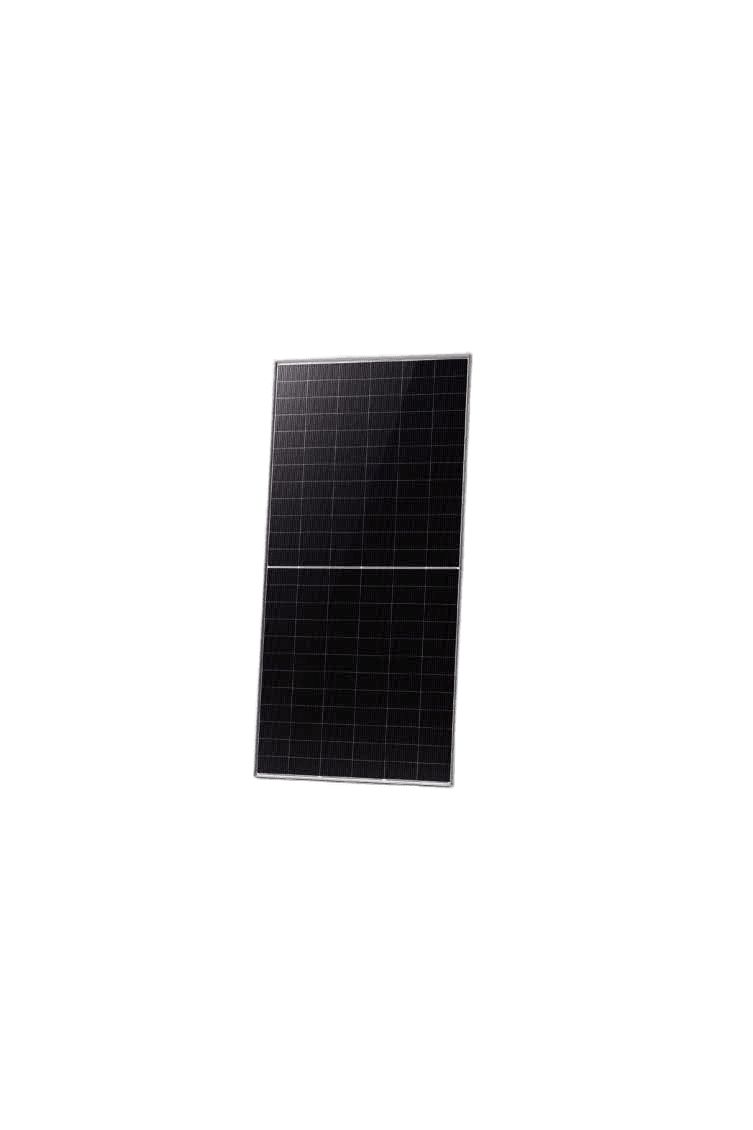
Cell chemistry in plain language — LID, PID, temperature coefficient and the degradation curve — read off Jinko's own N-type datasheets, including where N-type is not worth paying for.
Two dates decide whether a panel was a good buy
The first is the day the array is switched on, when the meter settles a little below the number printed on the box. The second is around year ten, when the same array is quietly producing less than the spreadsheet assumed and nobody can point to a fault. Nothing broke. The cells aged exactly as their chemistry said they would.
N-type against P-type is an argument about that second date. On commissioning day a buyer would struggle to tell the two apart from a bill; by year ten the gap has moved the return on the whole project. Here is where it comes from, using the figures printed on Jinko's own datasheets rather than a brochure claim.
What the letter actually refers to
Silicon on its own conducts almost nothing useful, so a trace of another element is added to give the wafer a surplus of one kind of charge carrier. Boron gives positive carriers — P-type, the base of the PERC modules that dominated the last decade. Phosphorus gives negative carriers — N-type, which is what every module in this catalogue uses.
The datasheet says so in the least glamorous place on the page. In the mechanical table of the JKM445-470N-48HL4M-BDV-Z2, one row reads Cell Type: N-type Mono-crystalline. That row, not the banner across the top of page one, is the claim you can hold a supplier to. The dopant sounds like a footnote. It is not, because boron does one specific unhelpful thing that phosphorus does not.
LID: the percent P-type pays in its first week
Boron in the wafer keeps company with oxygen left behind by crystal growth. Under the first strong sunlight the two form a defect pair that traps charge carriers, and output drops. This is light-induced degradation, and it is not gradual — most of it lands within days of the array being energised. It is why a brand-new P-type system so often measures below nameplate before anyone has climbed onto the roof to look for a reason.
N-type wafers carry essentially no boron, so the mechanism has nothing to work with. Jinko states the consequence rather than the chemistry: its TOPCon (Tunnel Oxide Passivating Contacts) cells "offer lower LID/LeTID degradation and better low light performance". The figure that matters sits in the warranty block — first-year degradation of 1% on every family checked here, against the 2% a mainstream PERC sheet typically reserves for itself. One point, taken once, never given back. Those PERC numbers are quoted as a class, not from a Jinko document: this catalogue is N-type end to end, so there is no in-house P-type sheet to cite.
PID: the failure that arrives around year six
Potential-induced degradation is a different animal. On a 1500 V string — and the Z2 sheet gives a maximum system voltage of exactly 1500 VDC — the modules furthest from ground sit at a high potential relative to their own frames, and over years that voltage drives sodium ions out of the glass into the cell. Power falls, sometimes steeply, and hits one end of a string far harder than the other, which is why PID is usually found as an unexplained mismatch between strings rather than as a fault code.
Jinko addresses it twice on the same sheet, and the two are not equally useful. Page one carries an Anti-PID Guarantee, minimising PID "through optimization of cell production technology and material control". The certificate list carries IEC62804 — the standard that exists specifically to test a module for PID — beside IEC61701 for salt mist, IEC62716 for ammonia and IEC60068 for sand and dust. A guarantee is a promise from the seller. IEC62804 is a test someone else ran. Ask for the second one.
Heat: what −0.29 %/°C is worth on a July roof
Every silicon module loses power as it warms, and the temperature coefficient of Pmax says how much per degree above the 25 °C of the nameplate measurement. In the Gulf that is not a detail: in July a module in still air sits at 65–75 °C, forty to fifty degrees above test conditions, during the hours when the air conditioning pulls hardest. The Z2 family is rated −0.29 %/°C and the QL6 families −0.26 %/°C; a typical PERC module sits near −0.34 %/°C.
| Cell temperature | Jinko N-type −0.29 %/°C | Jinko N-type −0.26 %/°C | Typical PERC −0.34 %/°C |
|---|---|---|---|
| 25 °C (STC) | 100% | 100% | 100% |
| 45 °C | 94.2% | 94.8% | 93.2% |
| 65 °C | 88.4% | 89.6% | 86.4% |
| 75 °C | 85.5% | 87.0% | 83.0% |
Read the last row honestly. Two to two and a half points at the worst moment of the day is real money, but it does not apply to the whole year — the module is cool at eight in the morning and cool in January. Across a Gulf year the coefficient is worth roughly one to two percent of total generation. A genuine advantage, and a modest one: anyone selling it as the main reason to choose N-type is overselling.
The degradation curve, in numbers you can bill
This is where the technologies actually separate, and Jinko prints the whole curve on page one: a first-year drop, a flat annual rate afterwards, and the floor the module is guaranteed to stay above in year thirty. The arithmetic is linear — 99% after year one, minus twenty-nine more years at the annual rate.
| Module family | Product warranty | Power warranty | Year 1 | Each year after | Year 30 floor | Pmax coefficient |
|---|---|---|---|---|---|---|
| JKM445-470N-48HL4M-BDV-Z2 | 15 years | 30 years | −1% | −0.40% | 87.4% | −0.29 %/°C |
| JKM525-545N-54QL6-DV-F1 | 15 years | 30 years | −1% | −0.35% | 88.85% | −0.26 %/°C |
| JKM645-670N-66QL6-BDX (SafetyKing) | 12 years | 30 years | −1% | −0.35% | 88.85% | −0.26 %/°C |
| JKM710-735N-66HL5-BDV-Z6 | 12 years | 30 years | −1% | −0.40% | 87.4% | −0.29 %/°C |
Two things deserve a pause. First, 99 − (29 × 0.40) = 87.4 and 99 − (29 × 0.35) = 88.85: the year-30 floor is not a marketing figure, it is the annual rate multiplied out, and if a sheet's three numbers do not reconcile, ask why before you order. Second, "N-type" is not one promise — inside this catalogue alone the product warranty is fifteen years on some families and twelve on others, and the annual rate is 0.35% or 0.40% depending on cell format. The letter tells you the chemistry; the warranty line tells you what you bought.
Set that against a mainstream PERC module: 2% in year one, 0.55% a year after, twenty-five years of power warranty rather than thirty. At year thirty the comparison is 87.4% against roughly 82%, and the P-type warranty had expired five years earlier in any case. Averaged over three decades the N-type array delivers on the order of 3% more energy from the same nameplate rating, before the temperature coefficient adds anything.
Where N-type is not worth paying for
All of that argues for the long hold. Four situations undo it, and one popular option is routinely bought for the wrong reason.
- A roof you will not own in year ten. A ten-year lease, a building earmarked for redevelopment, a site array that moves with the project — the whole advantage arrives after you have gone. Buy on price.
- A rear side that sees nothing. The bifacial figures are real: the 470 W module is rated 520 W under BNPI conditions, bifaciality 80±5% (85±5% on the QL6 families). They assume light reaching the back. Flush on a dark roof with no air gap, the rear contributes close to nothing and you have paid for glass you are not using.
- SafetyKing where the fire case does not demand it. Its 2.5 mm front and rear glass take the JKM645-670N-66QL6-BDX to 40.5 kg, against 32.5 kg for the standard 2.0 mm build in the same power class. Eight kilos a module is structure, and labour on every lift.
- Anti-glare glass as a yield upgrade. It is not one. Anti-glare exists so an array can be permitted beside a runway, a control tower or a motorway. If nobody objects to reflections, the ordinary anti-reflection coating is what works for you.
- Anti-dust instead of cleaning. It lengthens the interval between washes on a dusty site. It does not remove the wash from the maintenance budget, and a soiled anti-dust module produces exactly as little as a soiled ordinary one.
Ninety seconds with any datasheet
- Find the Cell Type row in the mechanical table: it should read N-type Mono-crystalline. A page-one banner is not a specification.
- Confirm there are two warranty numbers — product (12 or 15 years here) for the object, linear power (30 years) for the output. A lone "30-year warranty" claim conceals one of them.
- Multiply the annual rate out and check it lands on the printed year-30 floor.
- Read the Pmax coefficient beside the operating range: these sheets say −40 °C to +70 °C.
- Look for IEC62804 in the certificate list, not only the words "anti-PID".
- If the module is bifacial, find the bifaciality coefficient, then go and look at what the rear will actually see.
Do that on the 470 W Z2 and the sheet answers every question here: N-type mono cells, 96 half-cut cells in a 1762 × 1134 × 30 mm frame at 24.0 kg, dual 2.0 mm glass, 23.52% module efficiency, 0 ~ +3% power tolerance, and a curve ending at 87.4% in year thirty.
Frequently Asked Questions
Is N-type worth paying more for?
If you will own the array in year ten, yes — roughly 3% more energy averaged over thirty years from the degradation curve alone, plus one to two percent a year from the temperature coefficient in a hot climate. If the asset changes hands or the roof is temporary, no.
How can I prove a panel is N-type before it ships?
Read the Cell Type row in the datasheet's mechanical table: it must say N-type Mono-crystalline. Cross-check the warranty block, which on N-type sheets shows a 1% first-year figure rather than 2%.
Does a 30-year power warranty mean the panel lasts 30 years?
It means output is warranted to stay above a stated floor — 87.4% or 88.85% depending on the family. The product warranty covering the physical module is separate and shorter: twelve or fifteen years on the sheets quoted here.
Are all N-type panels equal?
No. Within this catalogue the annual rate is 0.35% or 0.40%, the coefficient is −0.26 or −0.29 %/°C, and the product warranty is twelve or fifteen years. Compare the lines, not the letter.
Frequently Asked Questions
Is N-type worth paying more for?
How can I prove a panel is N-type before it ships?
Does a 30-year power warranty mean the panel lasts 30 years?
Are all N-type panels equal?
Ready for a personalized quote?
WhatsApp us — average reply time under 15 minutes.