Gulf sites lose more to dust than to heat. What soiling, 70 °C cells and airport glare rules really cost — and which Jinko N-type build answers each one.
Three problems, three different answers
An array in Dubai, Dammam or Doha is working against three pressures at once, and they are not one problem wearing three names. Dust settles on the glass and quietly takes a share of every day's output. Ambient heat drives the cells far above the temperature the module was rated at, and every degree costs power. And on flat ground beside wide roads and busy airports, the light your array throws back can become somebody else's objection long before it becomes your yield.
Jinko's N-type range answers each one specifically: an anti-dust build, a lower temperature coefficient, an anti-glare front glass, a reinforced-glass model. They are not interchangeable, and buying all four when your site has one problem is the commonest way to overspend here. This guide separates them, and says plainly where each is not worth the money.
Soiling: the biggest loss on the list, and the cheapest to fix
Dust takes more energy from a Gulf array than heat does, and it is the only loss on this page you can reverse with a bucket of water. A film you can barely see costs a few per cent. A fortnight of still, dusty air in a rainless summer costs considerably more than that.
The pattern matters as much as the quantity. Dust does not settle evenly. It collects along the lower frame rail, where the frame acts as a small dam, and that band of shading sits directly across the bottom row of cells. A shaded row drags down the whole string it belongs to, which is why a module that looks ninety per cent clean can behave as though it were far dirtier than it looks.
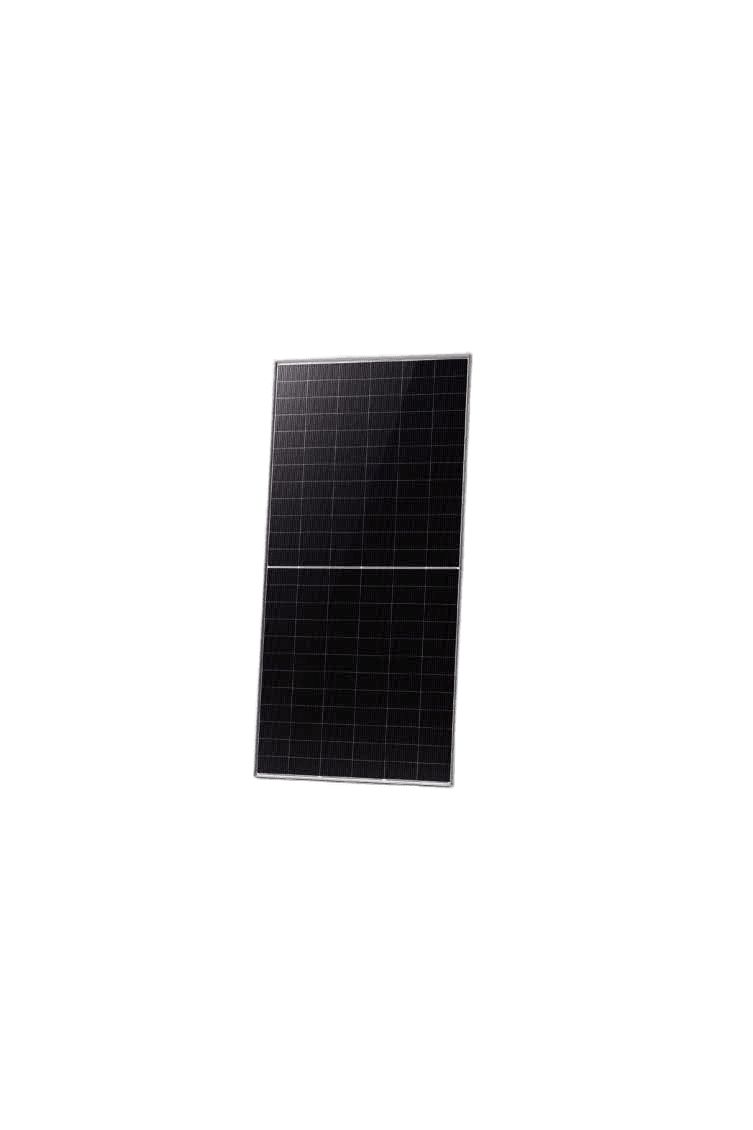
That is exactly the problem the anti-dust module is built around. The 645–670 W JKM645-670N-66QL6-BDV-L-AntiDust datasheet does not claim a coating on its own — it describes "special frame design and self-cleaning glasses" as one combined dust-proof solution. The frame is the half that buyers forget, and on a low-tilt Gulf roof it is the half that matters, because the frame is where the mud line forms.
When it is not worth buying. If your array sits on a roof with a water point, at fifteen degrees of tilt or more, and somebody washes it every two to four weeks, the anti-dust module will not repay its premium: you are already solving that problem with labour. It earns its money where washing is genuinely hard: remote ground mounts, near-flat roofs where water pools instead of running off, arrays beside an unpaved road or a quarry, and any site cleaned annually rather than monthly. Specify it for access, not for dust.
Heat: the number that matters is not the one on the front of the box
Every module in this range is rated at a cell temperature of 25 °C. No Gulf array sees that in daylight. On a 45 °C August afternoon a roof-mounted module runs at roughly 70 °C — some 45 degrees above the rating point — and the temperature coefficient of Pmax is what tells you the bill.
| Platform | Power band | Pmax coefficient | Approx. loss at 70 °C cell | Front / rear load |
|---|---|---|---|---|
| 48HL4M-BDV (residential) | 445–470 W | −0.29 %/°C | ~13.1 % | 6000 / 4000 Pa |
| 54QL6-DV | 525–545 W | −0.26 %/°C | ~11.7 % | 5400 / 2400 Pa |
| 66QL6-BDV (commercial) | 645–670 W | −0.26 %/°C | ~11.7 % | 5400 / 2400 Pa |
| 66HL5-BDV (utility) | 710–735 W | −0.29 %/°C | ~13.1 % | 5400 / 2400 Pa |
The arithmetic is worth doing once. At 70 °C a module rated −0.26 %/°C produces about 11.7 per cent below its nameplate; one rated −0.29 %/°C about 13.1 per cent below. The gap is 1.4 percentage points, present in every hot hour of every summer — trivial on a datasheet, not on a 500 kWp site, and a far better basis for comparing quotes than the nameplate wattage they are usually sold on.
Two qualifications belong here. First, the stated operating range is −40 °C to +70 °C, and Jinko's own footnote is specific: level T98 at or below 70 °C, short-term excursions to 85 °C, anything sustained beyond that requiring IEC TS 63126 testing. A sealed, zero-clearance roof mount in Kuwait in July crowds the top of that window, so leave the air gap — a hundred millimetres of clearance under the module buys more than a glass upgrade will.
Second, dual glass helps in this climate for a reason that is not thermal at all. With 2.0 mm heat-strengthened glass on the rear in place of a polymer backsheet, there is nothing back there to yellow, chalk or crack under thirty summers of Gulf ultraviolet.
The cold morning nobody sizes for
The temperature coefficient of Voc runs the other way, and it is what decides your string length. Inland Gulf sites reach 5 °C on a winter dawn — twenty degrees below the rating point. At −0.24 %/°C, a module whose open-circuit voltage is 50.50 V at STC opens at roughly 52.9 V on that morning. Against a 1500 V system ceiling that caps you at 28 modules in series, not the 29 the summer figures would suggest. Size strings on the coldest morning of the year. The inverter does not care that it only happens twice.
Glare: the constraint that can decide the module for you
Glare is the one item here with nothing to do with yield. Civil aviation authorities across the Gulf routinely ask for a glare assessment when an array falls inside an airport approach path or a control tower's sightlines, and municipality and highway reviewers ask the same of arrays overlooking a motorway or a neighbour's upper floors. When that assessment comes back requiring low-glare glass, the specification has been decided for you.
The answer in this range is the JKM645-665N-66QL6-BDV-AntiGlare, which replaces the usual anti-reflection coating with a 2.0 mm anti-glare front glass. The datasheet names the use case in as many words: airports and residential areas.
What it costs you, precisely. The anti-glare and standard modules are the same build — 264 cells, 2382 × 1134 × 30 mm, 32.5 kg, the same −0.26 %/°C, the same 5400 Pa and 2400 Pa load ratings. The difference shows up only at the top of the bin table: the standard reaches 670 W at 24.80 % efficiency, the anti-glare 665 W at 24.62 %. About seven-tenths of one per cent of output — a small price when a glare study demands it, pointless when nothing does. It answers a planning constraint, not a climate.
Wind, hail and the reinforced-glass option
The standard 66QL6 modules are certified to 5400 Pa on the front and 2400 Pa on the rear. In this region the rear figure is the one to read, because rear load is uplift, and uplift is what a shamal does to an open ground-mount array on flat desert.
The reinforced answer is the JKM645-670N-66QL6-BDX-SafetyKing: 7000 Pa front and 5000 Pa rear, hail strikes tested to 55 mm, and a Class A fire rating test report in place of the Class C on the standard sheets.
Be honest about which of those three you are buying. Hail at 55 mm is not a Gulf risk in any normal year, and nobody should be sold this module on that basis. Uplift is, and so is the insurer's question on an industrial roof, where a Class A report is often the line between an array being underwritten and refused. Specify SafetyKing for the 5000 Pa or the fire rating; treat the hail number as something you did not pay for.
One quiet detail is worth knowing. The small residential module — 445–470 W 48HL4M-BDV, 96 half-cells at 1762 × 1134 mm, 24.0 kg — is certified to 6000 Pa front and 4000 Pa rear, stronger than the large commercial module. Short panels are stiff panels, so on an exposed villa roof the small format is not the compromise it appears to be.
Matching the module to the site
| Site | Specify | Because |
|---|---|---|
| Villa roof, water on site, cleaned monthly | 445–470 W 48HL4M-BDV | 6000 / 4000 Pa on an exposed roof; small format works around parapets and plant |
| Commercial roof, quarterly cleaning at best | 645–670 W 66QL6-BDV-L Anti-Dust | Frame plus self-cleaning glass where washing is infrequent |
| Inside an airport approach, or facing housing | 645–665 W 66QL6-BDV Anti-Glare | The glare study will require it; costs one power bin |
| Open desert ground mount, shamal exposure | 645–670 W 66QL6-BDX SafetyKing | 5000 Pa rear uplift rating |
| Industrial roof with insurer fire conditions | 645–670 W 66QL6-BDX SafetyKing | Class A fire rating test report |
| Utility scale, driven by cost per watt | 710–735 W 66HL5-BDV | Fewest modules per megawatt; accept −0.29 %/°C |
What the warranty actually promises
Two warranty structures run through this range, and knowing which you are being quoted matters. The 66QL6 commercial platform carries a 12-year product warranty with a 30-year linear power warranty holding 88.85 % of nameplate at year 30, after a first-year degradation of no more than 0.35 %. The residential 48HL4M and 54QL6 modules carry a longer 15-year product warranty, the 30-year power warranty landing at 87.4 % after a first year of 0.40 %.
Read those as two separate promises. The product warranty covers the object — frame, glass, junction box, workmanship. The power warranty covers the output curve over time. Neither covers dust: no warranty here pays you back for a soiling loss, worth remembering the next time a supplier answers a cleaning question by quoting a warranty length.
For coastal sites the certifications matter more than most quotations admit. Every sheet in this range lists IEC 61701 for salt mist corrosion and IEC 62716 for ammonia, alongside IEC 61215:2021, IEC 61730:2023 and IEC 62804 for PID resistance. On a rooftop in Ajman or Al Khobar, a few kilometres from salt air, IEC 61701 is not a formality.
Frequently Asked Questions
Do I need an anti-dust panel in the Gulf?
Only if cleaning is hard. If the array has a water point and gets washed every two to four weeks at a tilt of 15 degrees or more, standard glass is fine. Choose the anti-dust build for remote ground mounts, near-flat roofs and sites cleaned once or twice a year.
Does anti-glare glass reduce output?
Slightly, and it is measurable. On the same 66QL6 platform, the standard module tops out at 670 W and 24.80 % efficiency while the anti-glare version tops out at 665 W and 24.62 % — about 0.7 % less. Buy it when a glare assessment requires it, not as a general upgrade.
How much power does Gulf heat actually cost?
At a cell temperature near 70 °C, expect roughly 11.7 % below nameplate on a module rated −0.26 %/°C, or about 13.1 % on one rated −0.29 %/°C. Clearance under the module and a lower temperature coefficient are the two levers you have.
Is the reinforced SafetyKing module worth the premium?
For open desert ground mounts and for industrial roofs with insurer fire conditions, yes — 5000 Pa of rear uplift and a Class A fire rating are the reasons. The 55 mm hail rating is not a Gulf argument and should not be the one that sells it to you.
Frequently Asked Questions
Do I need an anti-dust panel in the Gulf?
Does anti-glare glass reduce output?
How much power does Gulf heat cost?
Is the reinforced SafetyKing module worth the premium?
Ready for a personalized quote?
WhatsApp us — average reply time under 15 minutes.