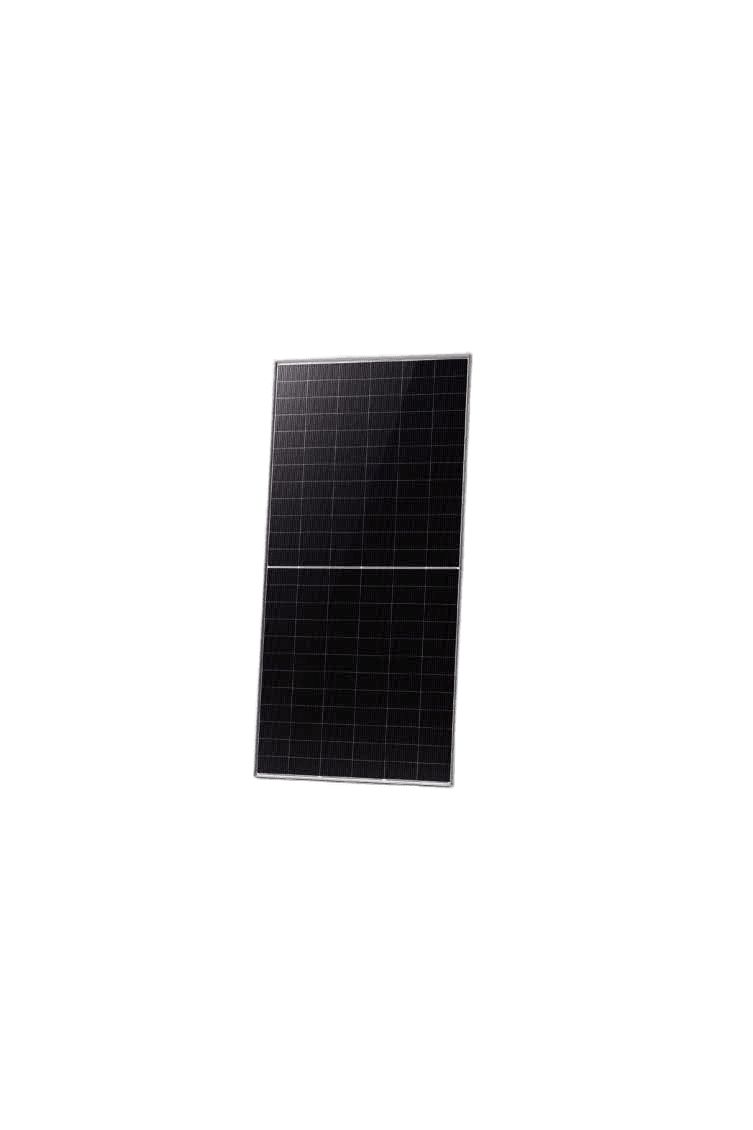
Jinko's datasheets put a real number on the rear face. Here is what bifaciality, albedo and mounting height are worth — and when to buy a mono-facial panel instead.
What "bifacial" means on the datasheet
A bifacial module is simply one built so its back can do work. On Jinko's N-type modules that means glass on both faces instead of glass and a plastic backsheet — 2.0 mm with an anti-reflection coating in front, 2.0 mm heat-strengthened behind — and cells finished so their rear surface collects light rather than being sealed away from it.
You need not take marketing's word for what that back is worth, because Jinko prints the number. Near the foot of every bifacial datasheet sits a line reading Bifaciality Coefficient: φPmax: 80±5% on the JKM445-470N-48HL4M-BDV-Z2, and 85±5% on the 66QL6 platform — the anti-glare, anti-dust and SafetyKing modules.
Read it plainly: a watt of light landing on the back is worth 0.80 (or 0.85) of a watt landing on the front. Note the tolerance too — "80±5%" is really a band from 75% to 85%, and any projection built on it inherits that width.
The arithmetic that predicts your gain
The gain from the second face is close to a single multiplication:
Extra output ≈ bifaciality coefficient × (light reaching the back ÷ light reaching the front)
Jinko lets you check that against its own measurements. Every bifacial datasheet carries a second, complete electrical table headed BNPI — bifacial nameplate irradiance — taken at 1000 W/m² on the front and 135 W/m² on the back. Since 135 is 13.5% of 1000, the formula predicts 0.80 × 13.5% = 10.8%. The published tables agree:
| Module | Bifaciality | Rated (STC) | BNPI | Gain |
|---|---|---|---|---|
| JKM445N-48HL4M-BDV-Z2 | 80±5% | 445 W | 493 W | +10.8% |
| JKM470N-48HL4M-BDV-Z2 | 80±5% | 470 W | 520 W | +10.6% |
| JKM735N-66HL5-BDV-Z6 | 80±5% | 735 W | 810 W | +10.2% |
| JKM665N-66QL6-BDV-AntiGlare | 85±5% | 665 W | 741 W | +11.4% |
That is the useful part of the whole subject. The module contributes one term — a coefficient it honours anywhere in the world — and your site contributes the other. The 135 W/m² is a laboratory condition chosen so modules can be compared; it is not a promise about your roof.
Albedo: the ground earns the money, not the module
The light reaching the back of a panel is mostly light that bounced off whatever lies beneath it. How much bounces is that surface's reflectance, or albedo. Typical published reflectance ranges for common surfaces look like this — these are properties of building materials, not Jinko specifications:
| Surface under the array | Roughly reflects | Verdict for a bifacial module |
|---|---|---|
| Fresh snow | 60–90% | Exceptional, and seasonal |
| White TPO or PVC membrane roof | 55–80% | The best year-round surface most buyers own |
| Pale concrete, light gravel, desert sand | 25–40% | Genuinely worthwhile |
| Grass, green or dried | 15–25% | Modest |
| Weathered dark roof tiles | 10–20% | Marginal |
| Dark bitumen, asphalt, black membrane | 5–15% | Close to nothing |
| Open water | 5–10% | Close to nothing |
Do the multiplication before you sign. A module at 80% bifaciality over a surface returning 6% of the front-side light to its back yields under 5%. The same module over bright gravel with a metre of clearance meets or beats the datasheet's 10.6%. A quotation promising a flat "+15% because it is bifacial", without naming your ground surface and mounting height, is quoting a brochure rather than your site.
The gain arrives as current, not voltage
This is the detail that costs installers money, and it is sitting in plain sight on the datasheet. Put the two tables for the 470 W module side by side:
| JKM470N-48HL4M-BDV-Z2 | STC (front only) | BNPI (both faces) |
|---|---|---|
| Open-circuit voltage, Voc | 36.87 V | 36.87 V |
| Voltage at max power, Vmp | 31.46 V | 31.46 V |
| Short-circuit current, Isc | 15.85 A | 17.55 A |
| Current at max power, Imp | 14.94 A | 16.54 A |
The voltages do not move at all. Every extra watt appears as current — about 10.7% more of it. Three consequences follow:
- String length is unaffected. You still size the string against cold-morning Voc and the 1500 V DC system limit, exactly as for a mono-facial panel.
- Everything carrying current is sized on the BNPI figure. DC cable, combiner busbars, isolators and the string fuse all see the higher number. The module permits a 35 A maximum series fuse, which leaves room — your combiner may not.
- Check the inverter's MPPT input current limit first. If a tracker input accepts 16 A per string and you designed against 15.85 A, a good-albedo site pushes past it and the inverter clips away the yield you paid extra for.
Mounting: what pays, and what quietly does not
The rear face converts only the light that reaches it, so mounting decides almost everything.
- Clearance first. A module clamped 100–150 mm above a roof sees that roof at close range, plus a great deal of its own shadow. Ground mounts and canopies that lift the array clear let the rear see a wide, brightly lit patch.
- Row spacing second. Tight rows shade each other's backs, and the spacing that prevents front-side shading in winter is rarely generous enough for the rear.
- Watch what you bolt behind the glass. Rails, cable trays, conduit and tracker torque tubes cast permanent shadows on a working face. The module's own junction box needs no deduction — the coefficient is measured on the finished module — but a tray you route across the back is a loss you added.
- Respect the rear load rating; it differs from the front. 48HL4M-BDV: 6000 Pa front, 4000 Pa rear. 66QL6-BDV: 5400 and 2400 Pa. SafetyKing: 7000 and 5000 Pa. Clamp inside the published zones.
- Vertical east–west fencing is a real option. Stood upright, the two faces watch opposite horizons and the array makes two peaks — mid-morning and late afternoon — instead of one at noon. On a site with no usable roof, that shape can beat a bigger noon figure.
The second benefit nobody quotes
A module raised for its rear face is also a module with moving air on both sides. Jinko rates power loss at −0.29 %/°C on the HL platforms and −0.26 %/°C on the 66QL6, so every 10 °C kept out of the cells is worth roughly 2.6–2.9% of output — on the front face, all day, every month. In hot markets that ventilation gain rivals the reflected-light gain, and unlike albedo it does not depend on what the owner paves the yard with next year.
When a bifacial module is not worth it
- A flush-mounted pitched roof with a dark covering. The commonest case, and the clearest answer. Jinko builds the same cell platform without a working back: the JKM450-475N-48HL4M-DB-Z3 (all-black) and -DV-Z4 carry the same 96 half-cut N-type cells, the same 1762×1134×30 mm frame, the same 24.0 kg, the same 6000 / 4000 Pa rating, the same −0.29 %/°C and the same 12-year and 30-year warranties. You forgo a rear gain your roof was never going to deliver, and nothing else.
- When the balance of system cannot take the current. If collecting the gain means a larger inverter, thicker cable or a new combiner, price that work first — sometimes it is trivial, sometimes it exceeds the energy it unlocks.
- When the rear will be dirty or obstructed. A low mount beside a dust road or in tall vegetation loses its back face to soiling and shadow. Dusty site, good mount: buy the anti-dust build. Dusty site and flush to a dark roof: bifacial is solving a problem you do not have.
- When the ground you were shown is not the ground that will stay. Pale gravel due to be asphalted, a white membrane due for a dark recoat, a yard about to be planted — each quietly deletes the gain the model was built on. Ask what the surface will be in year five.
One myth worth killing: bifacial does not mean heavier. The bifacial 48HL4M-BDV and the mono-facial 48HL4M-DB-Z3 both weigh 24.0 kg in the same frame. Thicker glass is what adds weight — SafetyKing, at 2.5 mm, is 40.5 kg against 32.5 kg for a standard 2.0 mm module on the same 66QL6 footprint.
What the warranty actually covers
Jinko's bifacial modules carry 12 years of product warranty against defects in materials and workmanship, and a 30-year linear power warranty. First-year degradation is capped at 1%, then 0.40% a year on the HL platforms — leaving 87.4% of rated output in year 30 — and 0.35% a year on the 66QL6, leaving 88.85%.
Read those percentages carefully: they are indexed to the module's STC rating, the front-side number. Rear-face gain is upside, never a warranty claim. The modules are certified to IEC 61215:2021 and IEC 61730:2023, with IEC 61701 salt-mist, IEC 62716 ammonia and IEC 62804 PID testing on top — the tests that matter on coastal, agricultural and humid sites, where a dual-glass laminate earns its keep.
Choosing between the bifacial builds
- Standard dual glass (BDV): 80±5% bifaciality, 445–735 W. The default for ground mounts, carports and commercial flat roofs.
- Anti-glare: 85±5% with anti-glare front glass — airport approaches, roadsides, close neighbours.
- Anti-dust: 85±5% with a dust-shedding treatment — desert and unpaved sites where soiling, not sunlight, is the limit.
- SafetyKing (BDX): 2.5 mm glass, 7000 / 5000 Pa, class A fire rating, hail tested to 55 mm — exposed, windy and hail-prone sites.
Tell us the surface under the array and the clearance you can reach, and we will do the multiplication with you — and say plainly if the mono-facial module is the better buy.
Frequently Asked Questions
How much extra energy does a bifacial panel actually produce?
What is the bifaciality coefficient on Jinko modules?
Do bifacial panels need a different inverter?
When should I buy a mono-facial panel instead?
Does the warranty cover the bifacial gain?
Ready for a personalized quote?
WhatsApp us — average reply time under 15 minutes.