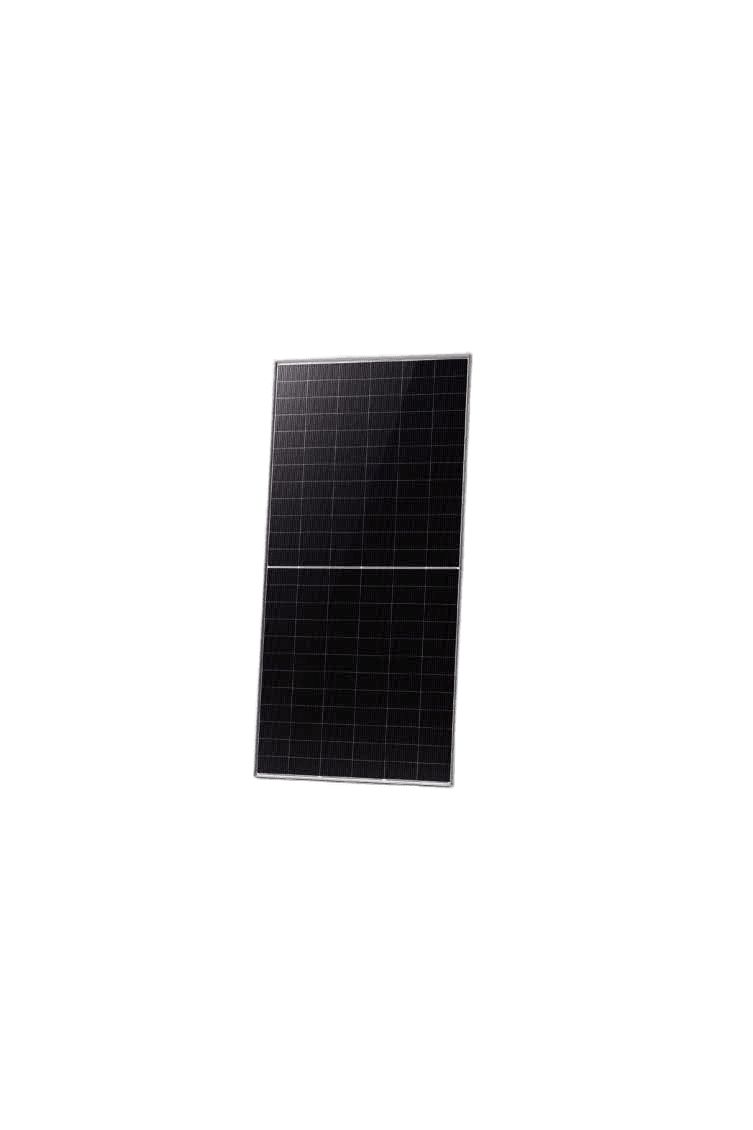
Bigger is not automatically better. How Jinko's 445 W to 735 W N-type modules really compare on roof area, string sizing, weight and inverter limits.
Watts are a label, not a measurement of your roof
A 735 W panel sounds like it must beat a 470 W panel by half again. On a datasheet it does. On a roof it frequently does not — and everything below is taken straight off Jinko's own published datasheets, with no rules of thumb and no estimates.
Every module across the 445 W to 735 W range is built the same way: N-type mono-crystalline cells, two 2.0 mm glass sheets, an anodised aluminium frame, an IP68 junction box, a 1500 VDC system rating. What changes from one model to the next is the size of the rectangle — and the rectangle is the part your roof actually reacts to.
Power per square metre, not power per panel
Divide each module's rating by the area its datasheet gives:
| Module | Dimensions | Area | Top rating | Watts per m² |
|---|---|---|---|---|
| 48HL4M (445–470 W) | 1762 × 1134 mm | 2.00 m² | 470 W | 235 |
| 54HL4M (495–520 W) | 1961 × 1134 mm | 2.22 m² | 520 W | 234 |
| 54QL6 (525–545 W) | 1980 × 1134 mm | 2.25 m² | 545 W | 243 |
| 66QL6 (650–670 W) | 2382 × 1134 mm | 2.70 m² | 670 W | 248 |
| 78HL4 (625–650 W) | 2465 × 1134 mm | 2.80 m² | 650 W | 233 |
| 66HL5 (710–735 W) | 2384 × 1303 mm | 3.11 m² | 735 W | 237 |
The densest module in the catalogue is not the biggest one. The 66QL6 at 670 W is rated 24.80% efficient on its datasheet; the 66HL5 at 735 W is rated 23.66%. Cover the same roof with each and the 670 W module puts about 5% more kilowatts on it. The 735 W module is not a better panel. It is a bigger panel.
The roof that changes its mind at sixty centimetres
Even the area table flatters the large module, because panels arrive in whole units and roofs arrive as awkward rectangles. Take a clear roof 8.0 m wide, panels mounted portrait.
At 5.0 m deep: seven columns fit across the 8.0 m (1134 mm each). Two rows of the 2382 mm module use 4.76 m of depth, so fourteen 670 W modules go on — 9.38 kW. The 1762 mm module also manages only two rows, because a third would need 5.29 m. Fourteen modules at 470 W — 6.58 kW. The big module wins by nearly 3 kW.
At 5.6 m deep: the 2382 mm module still fits two rows and nothing changes — 9.38 kW. The 1762 mm module now fits three rows in 5.29 m. Twenty-one modules at 470 W — 9.87 kW. Sixty centimetres of roof depth reversed the answer.
That is the whole argument in one example. Nobody can name the right wattage for your roof without a measured drawing of it, and a supplier who quotes a wattage before seeing the dimensions is guessing.
What your inverter will and will not accept
Two lines on the inverter datasheet decide whether a module can be used at all.
The voltage ceiling. Open-circuit voltage climbs as the panel cools: −0.25 %/°C on the 48HL4M and 66HL5 modules, −0.24 %/°C on the QL6 modules. The 470 W module leaves 36.87 V at 25 °C and presents roughly 38.4 V on an 8 °C winter morning. The 670 W module moves from 50.60 V to about 52.7 V; the 735 W module from 49.52 V to about 51.6 V. Against a 600 V inverter ceiling that is fifteen, eleven and eleven modules per string — 7.05 kW, 7.37 kW and 8.09 kW. Here the large module genuinely wins: it buys more watts per volt of string budget.
The current ceiling — where large modules get refused. Short-circuit current is 15.85 A on the 470 W module, 16.34 A on the 670 W, and 18.88 A on the 735 W. A great many residential hybrid inverters rate each MPPT input at 16 A short-circuit. The 735 W module is over that on paper before anyone measures the roof, and because these are bifacial the datasheet's own bifacial-condition figures put the 66HL5 at up to 20.87 A over a reflective surface. Find the "maximum short-circuit current per MPPT" line on your inverter before you choose a wattage, not after.
How many trackers you have. A three-MPPT inverter on a villa roof with three orientations needs enough modules to split sensibly. Fourteen divide 5 / 5 / 4. Nine divide 3 / 3 / 3 and leave you nothing to trade. Fewer, larger panels means coarser control of a complicated roof.
Weight: the surprise is that there isn't one
The range runs 24.0 kg at 445–470 W, 27.0 kg at 495–520 W, 27.5 kg at 525–545 W, 32.5 kg at 645–670 W and 37.5 kg at 710–735 W. That reads like a steep climb until you divide by area — every one of them lands between 12.0 and 12.2 kg per square metre. Your roof structure carries the same dead load per square metre whichever module you pick. The extra kilograms do not go into the building. They go into the two people lifting.
Which still matters a great deal. A 37.5 kg module measuring 2384 × 1303 mm is a 3.1 m² sail; in a strong wind it is a two-person carry with a third steadying it, and it will not go up an internal villa staircase or a light ladder hoist. On a site with a telehandler and a clear run, none of that is a problem. On a villa with a parapet and a stairwell, the 24.0 kg module at 1762 × 1134 mm is the one that actually gets installed.
Wind, heat, and the hours that pay
The smallest module in the range is also the toughest. The 48HL4M is certified to 6000 Pa front and 4000 Pa rear static load; everything from 495 W upwards is certified to 5400 Pa and 2400 Pa. On an exposed roof or a high parapet that is a real difference, and it points the opposite way from wattage.
Heat points a third way again. Power falls at −0.29 %/°C on the HL4M, 78HL4 and HL5 modules, and at −0.26 %/°C on the QL6 modules. At a 65 °C cell temperature — an ordinary Gulf afternoon — that is a loss of 11.6% against 10.4%. The QL6 platform is simultaneously the most efficient and the least heat-sensitive in the catalogue, and it is not the biggest panel in it.
Warranty does not scale with size either
Every module here carries a 30-year linear power warranty, but the product warranty and the end point differ by family — and not in the direction you would guess:
- 450–475 W (48HL4M-DB-Z3): 25-year product warranty — the longest in the range, on one of the smallest modules.
- 445–470 W (48HL4M-BDV-Z2), 495–520 W, 525–545 W: 15-year product warranty.
- 605–735 W families: 12-year product warranty.
The performance floor differs too. The HL4M and HL5 modules lose 1% in year one and 0.40% a year afterwards, arriving at 87.4% in year 30. The QL6 modules lose 1% then 0.35% a year, arriving at 88.85%. Over three decades that gap is worth more than a few extra watts on day one.
The coated variants, and when they are not worth buying
Three specialist builds sit in the 645–670 W band. Each earns its money only under a specific condition.
- Anti-glare glass: buy it when a planning authority, an airport approach, a motorway or an overlooking tower means you will face a glare assessment. Otherwise it is a coating nobody will ever measure, and the standard anti-reflection glass fitted to every other model is the better buy.
- Anti-dust (special frame plus self-cleaning glass): worth it on a remote desert site with no wash water and no cleaning contract. On a villa with an accessible roof and a monthly rinse, a hose does the same job for nothing.
- SafetyKing: 7000 Pa front and 5000 Pa rear, hail up to 55 mm, fire rating class A. Buy it where an insurer or a fire code asks for class A, or where hail is a genuine local risk. In the Gulf the risks are wind and sand, not hail — so on most roofs here that premium is better spent on the mounting system.
Container maths, if you are buying a project
Landed cost per watt is decided partly by how many watts fit in a 40' HQ. Straight from the packing tables: 962 modules of 470 W is 452 kW; 864 of 545 W is 471 kW; 720 of 670 W is 482 kW; 594 of 735 W is 437 kW. The 78HL4 ships 576 pieces at 650 W — 374 kW, the lowest density in the range. At container scale the 66QL6 moves roughly 10% more capacity per box than the 735 W module does.
A short decision table
| Your situation | Choose | Because |
|---|---|---|
| Villa roof cut up by AC plant, tanks, a stairwell | 445–470 W (1762 × 1134 mm, 24.0 kg) | Fits leftover strips; two people can carry it up a stair |
| Clean rectangular roof, no shade | 650–670 W 66QL6 | Highest watts per m² in the range (24.80% at 670 W) |
| Very hot roof, long summer | 54QL6 or 66QL6 (−0.26 %/°C) | 1.2 points less loss at a 65 °C cell |
| Warehouse roof, carport, long clean rows | 710–735 W | Fewest rails, clamps and mounting points per kW |
| Ground mount over gravel or white membrane | 66QL6 (85 ± 5% bifaciality) | Best rear-side gain in the catalogue |
| Exposed roof, high parapet, strong wind | 48HL4M (6000/4000 Pa) or SafetyKing (7000/5000 Pa) | Highest static load ratings in the range |
| Existing inverter, 16 A per MPPT | Anything except 710–735 W (18.88 A) | The 735 W module is over the input rating on paper |
Frequently Asked Questions
Is a 735 W panel better than a 470 W panel?
Not per square metre. The 735 W module delivers 237 W/m² and the 650–670 W 66QL6 delivers 248 W/m², so on a fixed roof area the mid-size module wins. The 735 W module earns its place where mounting labour and rail count dominate — carports, warehouse roofs, long clean rows.
Will a bigger panel work with the inverter I already own?
Check two numbers. Cold-morning open-circuit voltage against the inverter's maximum DC voltage, and the module's short-circuit current against the maximum short-circuit current per MPPT. At 18.88 A the 710–735 W module exceeds the 16 A input rating common on residential hybrids; at 15.85 A and 16.34 A the 470 W and 670 W modules usually do not.
Do bigger panels put more weight on my roof?
No. From 24.0 kg to 37.5 kg, every module in the range works out at 12.0 to 12.2 kg per square metre, so the dead load per square metre is effectively identical. The extra weight is a handling problem on installation day, not a structural one.
Frequently Asked Questions
Is a 735 W panel better than a 470 W panel?
Will a bigger panel work with the inverter I already own?
Do bigger panels put more weight on my roof?
Ready for a personalized quote?
WhatsApp us — average reply time under 15 minutes.